
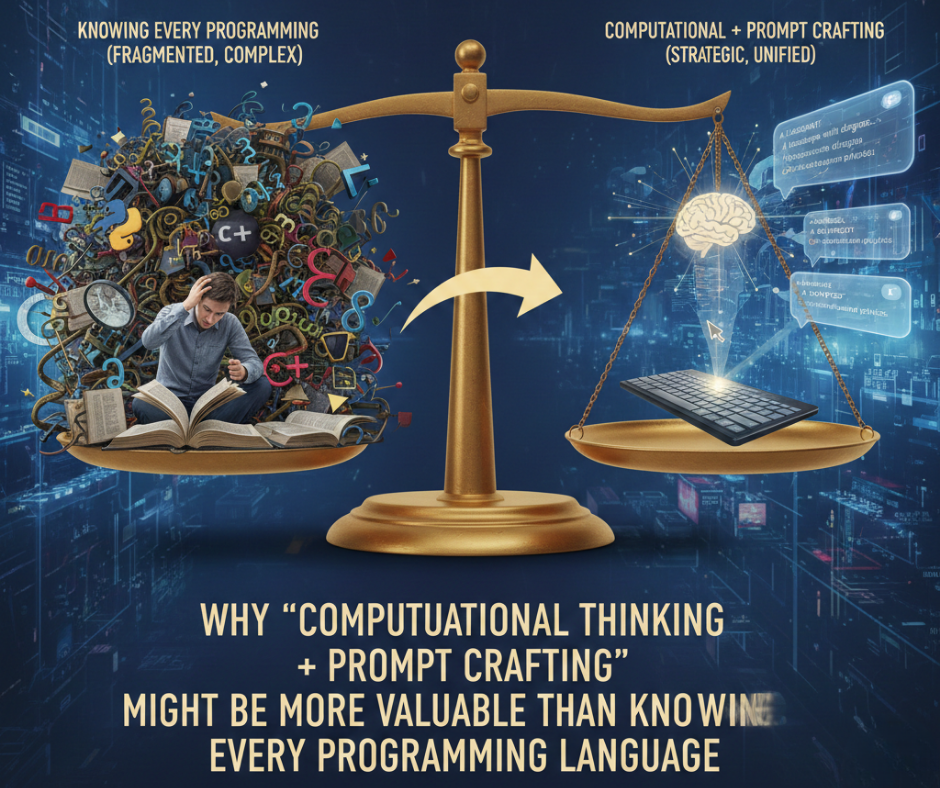
Why “Computational Thinking + Prompt Crafting” Might Be More Valuable Than Knowing Every Programming Language
In the fast-paced world of technology, students, freelancers, and professional developers often feel pressure to learn every programming language—from Python and JavaScript to Rust and Go. While coding skills are undeniably important, the rise of AI, no-code platforms, and low-code tools is shifting the focus.
Increasingly, two skills are becoming more valuable than knowing every syntax: computational thinking and prompt crafting. Together, they equip developers to solve problems efficiently, leverage AI tools effectively, and adapt quickly to new technologies.
Let’s explore why this combination might be the future of tech skills.
1. What Is Computational Thinking?
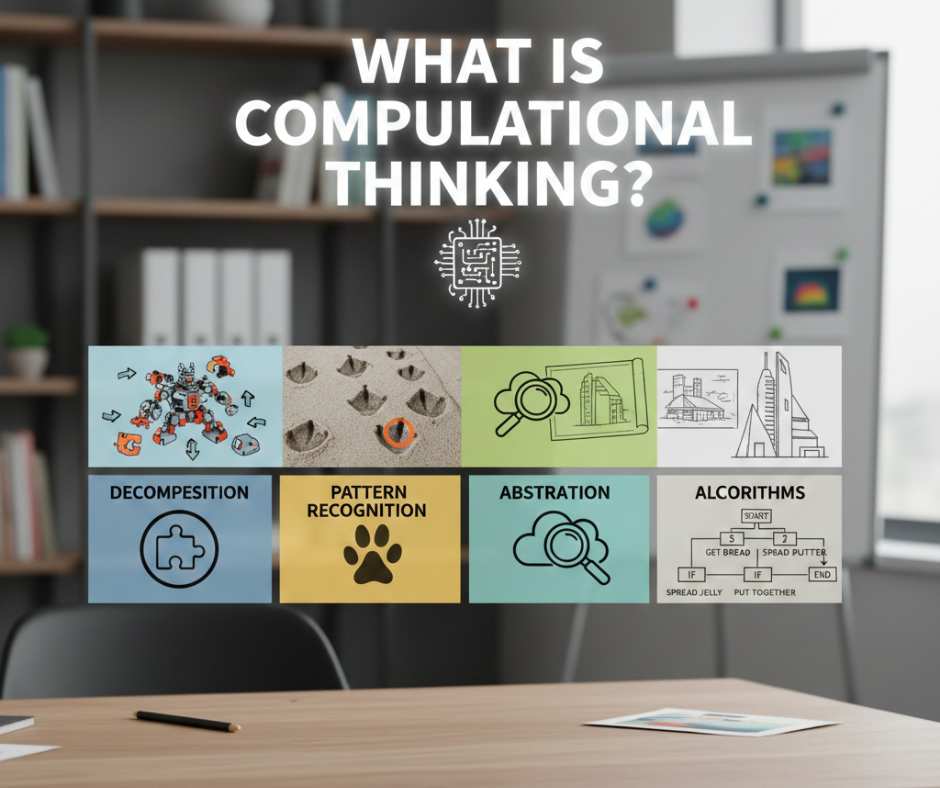
Computational thinking (CT) is a problem-solving approach that breaks complex problems into manageable parts, identifies patterns, and designs solutions in a structured way.
Key components of computational thinking include:
- Decomposition: Breaking a problem into smaller, solvable pieces
- Pattern recognition: Identifying similarities across problems
- Abstraction: Focusing on important details while ignoring irrelevant ones
- Algorithmic thinking: Creating step-by-step solutions
CT isn’t tied to a specific programming language. Instead, it gives you a framework for thinking like a developer, no matter what tools or technologies you use.
2. What Is Prompt Crafting?
Prompt crafting refers to the ability to communicate effectively with AI tools, such as ChatGPT, MidJourney, or AI-driven code assistants.
Good prompts allow you to:
- Generate accurate code snippets
- Automate repetitive tasks
- Create content and documentation
- Explore problem-solving strategies
In essence, prompt crafting amplifies your computational thinking, allowing AI to execute solutions while you guide and validate them.
3. Why This Combination Is More Valuable Than Memorizing Languages
a) Technology Changes Faster Than You Can Learn It
New programming languages, frameworks, and libraries emerge every year. For example:
- JavaScript frameworks like React, Vue, and Svelte constantly evolve
- New languages like Rust and Go gain traction
- AI-assisted coding tools are changing how developers work
No developer can master all languages. Instead, those with strong computational thinking and AI skills can adapt to any new tool quickly.
b) Problem-Solving Matters More Than Syntax
A developer’s true value comes from solving problems efficiently, not memorizing syntax.
For example:
- AI can generate boilerplate code in seconds
- No-code platforms handle UI and backend logic automatically
- Developers with strong CT can identify what problem to solve and how
Understanding how to approach problems is more versatile than knowing the syntax of a dozen languages.
c) AI Tools Reduce the Need for Language Mastery
AI-assisted tools can now:
- Translate concepts into multiple languages
- Suggest optimizations and best practices
- Handle repetitive coding tasks
With the right prompt, a developer can leverage AI to write code in languages they may never have used before. Prompt crafting becomes a multiplier for productivity.
d) Promotes Creativity and Innovation
Combining computational thinking with prompt crafting frees developers to focus on creative solutions:
- Experimenting with architectures
- Rapid prototyping
- Testing new ideas without worrying about language limitations
Instead of spending weeks learning a new syntax, developers can bring ideas to life immediately.
4. How Students Can Apply This Approach
Students entering tech careers can benefit greatly by prioritizing CT + prompt skills:
- Learn problem-solving first
- Practice breaking down complex tasks into manageable steps
- Use flowcharts, diagrams, and pseudocode
- Experiment with AI-assisted tools
- Practice generating code snippets, content, or design workflows using prompts
- Iterate and refine prompts to get better results
- Focus on cross-functional skills
- Understand databases, APIs, and UX principles
- Learn to integrate multiple tools to solve real-world problems
- Use multiple languages sparingly
- Learn just enough syntax to validate AI outputs
- Spend more energy on understanding concepts and AI integration

5. How Freelancers Can Benefit
Freelancers who combine CT with prompt crafting can:
- Deliver faster results for clients
- Tackle projects in languages they may not know deeply
- Build solutions using a combination of AI, no-code, and custom scripts
- Offer a premium skill set focused on solving problems, not just coding
This approach makes freelancers more versatile and marketable, especially in 2026 and beyond.
6. The Future: Adaptability Over Memorization
The tech landscape in 2026 will reward adaptability over rote memorization. Developers who can:
- Analyze problems critically
- Leverage AI tools effectively
- Communicate requirements clearly
- Validate solutions
…will thrive regardless of which programming language dominates the market.
Computational thinking + prompt crafting = future-proof skill set.
Conclusion
While knowing programming languages remains valuable, the real game-changer for developers in 2026 is how you think and how you communicate with AI.
By mastering computational thinking, students and freelancers can approach problems systematically. By learning prompt crafting, they can leverage AI to accelerate development and expand their capabilities beyond any single language.
In a world where technology evolves rapidly, the ability to think, adapt, and direct AI effectively may be more valuable than memorizing every programming language.
Invest in your thinking skills today, and let AI amplify your output tomorrow.