
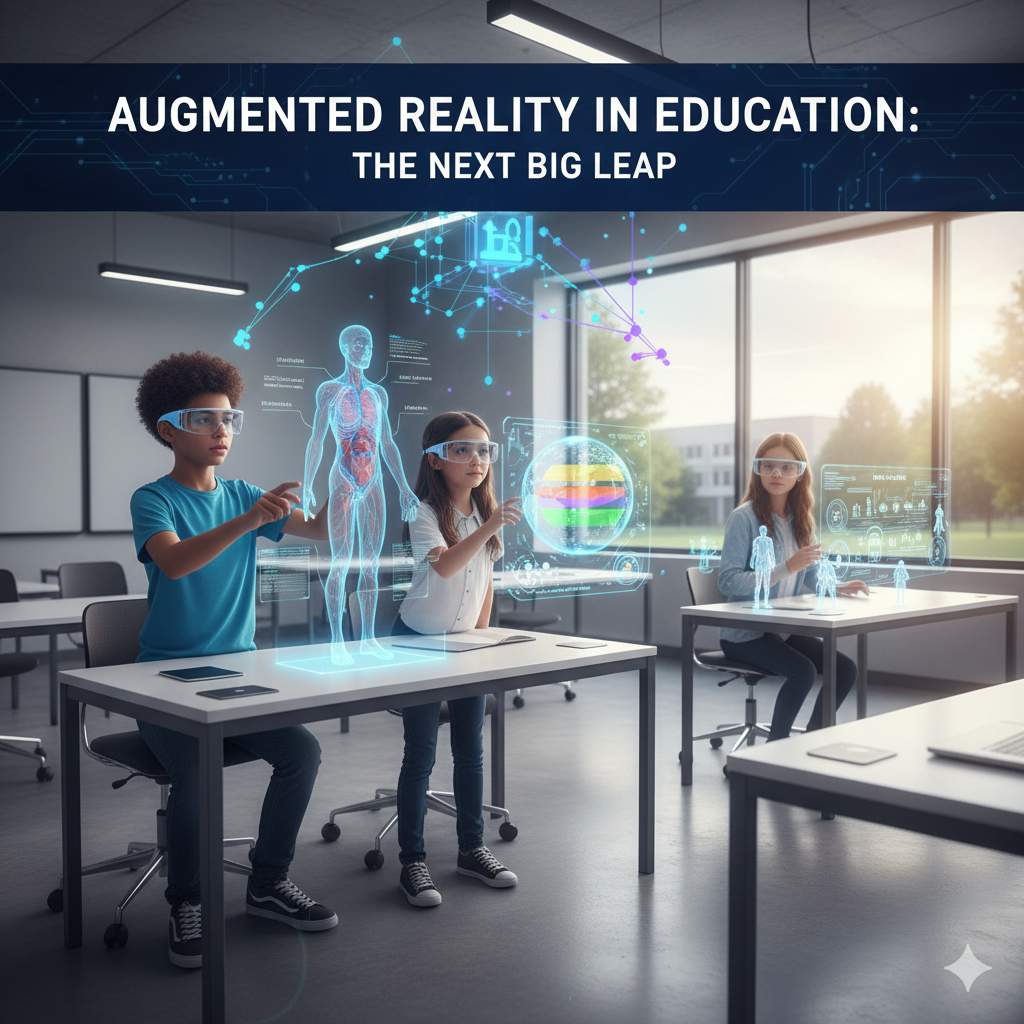
Augmented Reality in Education: The Next Big L
Education has come a long way from chalkboards and printed books. In today’s digital era, students and teachers are connecting through virtual classrooms, online platforms, and immersive technologies. And leading this transformation is Augmented Reality (AR) — one of the most exciting innovations in modern learning.
By blending digital information with the real world, AR is changing how we teach, learn, and experience knowledge. It’s not just a futuristic concept anymore — it’s happening right now, shaping schools, universities, and online education platforms across the globe.
Let’s explore how Augmented Reality in education is becoming the next big leap in learning and why every educator and student should know about it.

What Is Augmented Reality (AR)?
Augmented Reality (AR) overlays digital elements — like images, videos, sounds, or 3D objects — on top of the real-world environment through devices like smartphones, tablets, or AR glasses.
In simple words, AR adds interactive digital content to what you see in real life.
Think about:
- Viewing a 3D human body model while studying biology
- Using your phone camera to visualize the solar system in your room
- Seeing step-by-step digital guides while learning to design a WordPress website
That’s the power of AR — it turns passive learning into hands-on, immersive experiences.
The Rise of AR in Education
Over the past few years, online learning platforms have grown rapidly. But in 2025, the focus is shifting from watching and reading to experiencing and interacting — and AR makes that possible.
Big tech companies like Google, Apple, and Meta are heavily investing in AR for education. Even schools and universities are adopting AR-based learning tools for science, history, engineering, and digital skills training.
According to recent studies, students retain up to 80% more information when learning through interactive experiences like AR compared to traditional classroom methods.

How AR Enhances the Learning Experience
1. Learning by Doing
AR allows students to see and interact with lessons in real time. For example, a marketing student can explore a 3D version of an online sales funnel or visualize how Google’s algorithms rank content.
This “learning by doing” approach improves understanding, especially for visual and kinesthetic learners.
2. Increased Engagement and Motivation
Let’s face it — long text-based lessons can be boring. But with AR, learning feels like playing a game. Students are curious, active, and engaged.
For educators teaching digital skills like SEO, social media marketing, or website design, AR can help demonstrate processes visually — such as how a keyword ranks, how ads appear on screens, or how website elements interact in real time.
3. Bridging the Gap Between Online and Offline Learning
AR creates a smooth connection between real-world learning and digital content. For instance, while studying digital marketing, students can scan a QR code on a brochure and see an AR animation showing how campaigns are tracked online.
It combines physical and digital worlds — perfect for today’s hybrid education systems.
4. Safe and Practical Learning Environment
In technical fields like medicine, engineering, or design, AR provides safe simulations where students can experiment without real-world risks.
Similarly, in WordPress and website development training, AR can be used to visualize a site’s structure, layout, and user journey before even launching it.
AR in Online Education Platforms
Online academies and eLearning websites are already integrating AR to make digital lessons more interactive.
Here’s how AR can enhance your online learning experience:
- Interactive video lessons: Students can explore AR visuals within tutorials.
- 3D learning models: Perfect for design, marketing analytics, or branding strategy visualization.
- Gamified lessons: Turn digital marketing challenges into AR missions and quizzes.
- Virtual classrooms: AR-enabled platforms allow students and teachers to interact with digital objects in real time.
For platforms like yours — which teach SEO, WordPress, and digital marketing — AR could become a major tool for demonstrating real-world application of strategies and tools in a dynamic, visual way.
Benefits of AR for Students and Teachers
For Students:
- Makes complex topics simple and visual
- Boosts confidence through hands-on learning
- Increases memory retention and understanding
- Encourages creativity and critical thinking
For Teachers and Trainers:
- Makes lessons more interactive and exciting
- Helps explain technical subjects visually
- Improves student engagement and feedback
- Differentiates your course from traditional teaching methods
Real-World Examples of AR in Education
- Google Expeditions: Students can explore virtual field trips — from the Great Wall of China to the surface of Mars.
- Anatomy 4D: Medical students use AR to study human anatomy through 3D visuals.
- Merge Cube: Lets students hold digital 3D objects in their hands using AR.
- AR Flashcards: Helps children learn with fun and engaging digital content.
Soon, we’ll also see AR in digital marketing education — helping learners visualize analytics, campaign structures, and website traffic flow like never before.
Challenges of AR in Education
Like any new technology, AR in education has its challenges:
- High development costs for AR content
- Limited access to AR devices in some regions
- Need for teacher training and curriculum integration
However, as the technology becomes more affordable, we’ll see AR become a standard tool in classrooms and online courses worldwide.
The Future of AR in Learning
By 2030, AR is expected to be part of almost every digital learning platform. Imagine learning SEO through 3D visual tools, or exploring a WordPress website in AR mode, where you can walk through a virtual site and interact with its pages.
That’s where the future is headed — immersive, practical, and visual learning experiences that bridge theory and reality.
Final Thoughts: Embrace the Future of Digital Learning
Augmented Reality is not just a tech buzzword — it’s the future of education.
It transforms how students learn, how teachers teach, and how knowledge is experienced.
If you’re passionate about learning digital skills like SEO, WordPress, and digital marketing, staying updated with AR trends gives you a huge edge. It helps you understand how technology will shape the next generation of online education and digital work.
At our platform, we’re dedicated to helping students learn future-ready skills — from mastering SEO to understanding the next big wave of digital transformation.
👉 Join our online courses today and start learning skills that make you stand out in the digital world.
Let’s learn, grow, and innovate — together! 🌐✨