
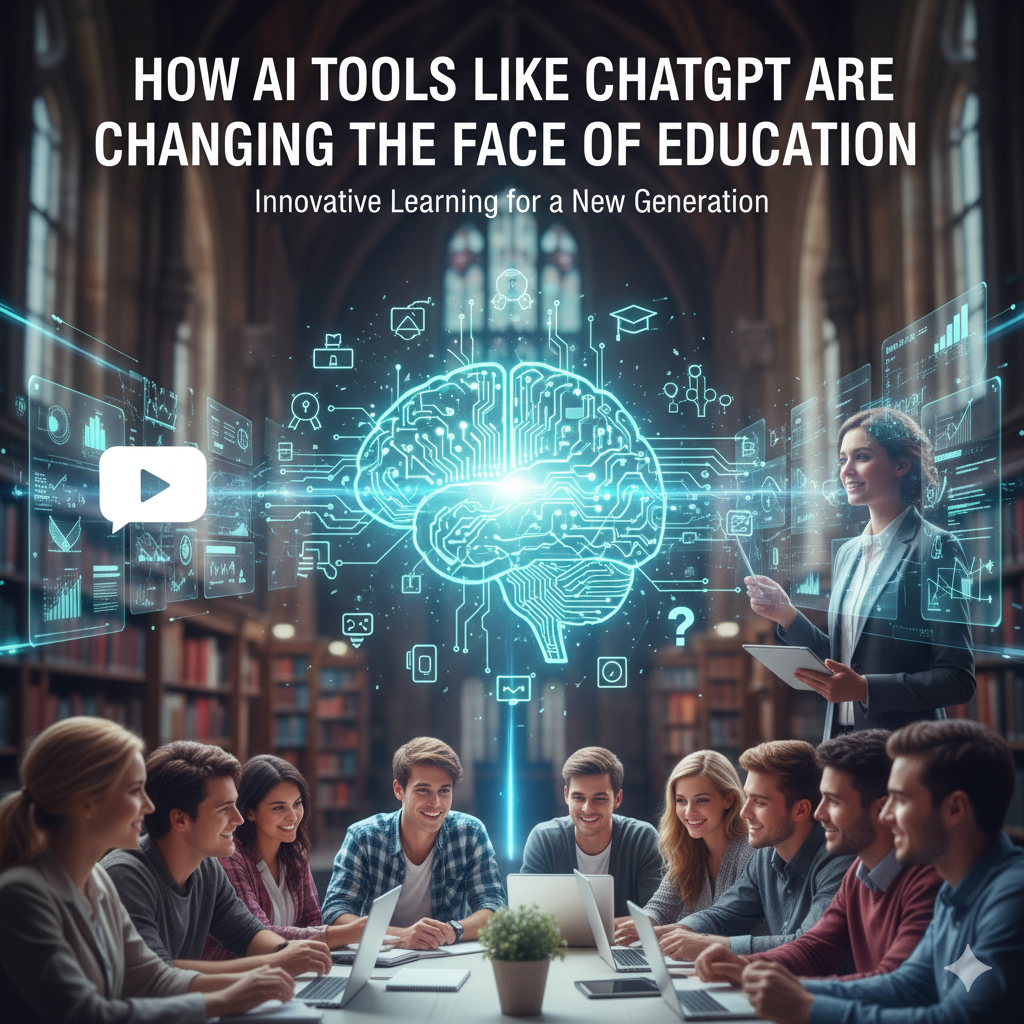
How AI Tools Like ChatGPT Are Changing the Face of Education
Artificial Intelligence (AI) is no longer just a futuristic concept — it’s now a powerful reality reshaping industries, and education is one of the sectors experiencing the biggest transformation. Among the most impactful innovations is ChatGPT, an advanced AI language model developed by OpenAI.
From personalized tutoring and content creation to academic research and coding assistance, ChatGPT and similar AI tools are redefining how students learn and teachers teach. Let’s explore how these technologies are changing the face of education and creating a smarter, more accessible learning environment for everyone.
1. Personalized Learning for Every Student
One of the biggest challenges in education has always been that every student learns differently. Traditional classrooms often struggle to keep up with individual learning speeds, styles, and comprehension levels.
ChatGPT bridges this gap by offering personalized learning experiences. A student can ask the AI to explain a concept in simpler terms, request examples, or even ask for step-by-step problem-solving.
For example:
- A math student can ask, “Explain trigonometry like I’m 12 years old.”
- A computer science student can ask, “Help me debug my Python code.”
- A literature student can request, “Summarize Shakespeare’s Macbeth in 200 words.”
The ability to get instant, tailored responses allows students to learn at their own pace — something traditional classrooms rarely offer.
2. 24/7 AI Tutoring and Homework Help
AI-powered tools like ChatGPT are available 24/7, breaking down the barriers of time and location. Whether it’s midnight before an exam or an early-morning assignment rush, students can use AI chatbots for quick explanations, practice quizzes, and detailed feedback.
Unlike human tutors, ChatGPT never gets tired or impatient. It can explain a topic repeatedly, provide alternative examples, and even quiz the student to reinforce learning.
This accessibility makes AI tutoring especially valuable in areas with limited educational resources or teacher shortages. It brings quality education to remote learners, ensuring no one is left behind.
3. Streamlining Teachers’ Workload
AI isn’t replacing teachers — it’s empowering them. Educators often spend countless hours on repetitive tasks such as grading, lesson planning, and feedback. With AI tools like ChatGPT, these tasks become significantly easier.
Teachers can:
- Generate lesson outlines and course summaries
- Create quizzes and tests with answer keys
- Get assistance in writing progress reports
- Simplify complex subjects for younger learners
By automating administrative and creative tasks, teachers can focus more on student engagement, critical thinking, and interactive learning — areas where human connection remains irreplaceable.
4. Research and Academic Writing Support
Students and researchers often struggle with structuring essays, writing reports, or finding relevant sources. ChatGPT acts as a research assistant, helping with:
- Drafting outlines and abstracts
- Suggesting titles or keywords
- Summarizing research papers
- Explaining complex academic theories
For instance, a university student writing a thesis on “AI Ethics in Education” can use ChatGPT to generate an outline, then refine it with human analysis and citation research. This hybrid approach — AI for drafting and humans for refining — boosts productivity and academic quality.
5. Language Learning Made Easier
AI tools like ChatGPT are excellent for language learners. They can translate sentences, correct grammar, and even simulate conversations in multiple languages.
A learner can practice English, Spanish, or Japanese by chatting with the AI, asking for pronunciation help or vocabulary explanations. ChatGPT can even role-play as a native speaker, providing contextual and conversational practice that textbooks can’t match.
Language teachers can also use AI to create customized lesson plans, vocabulary lists, and interactive dialogue exercises tailored to each student’s level.
6. Enhancing Online Learning Platforms
E-learning platforms like TechAcademy and other online schools are integrating AI to enhance user experience. AI chatbots can:
- Answer course-related queries
- Recommend learning paths based on performance
- Provide instant feedback on quizzes
- Suggest additional resources for improvement
For example, if a student struggles with a JavaScript module, the AI can suggest tutorials, exercises, or related blog posts. This data-driven personalization keeps learners motivated and helps them achieve better results.
7. Developing Critical Thinking and Creativity
While AI helps students learn faster, it also encourages critical thinking. When learners ask ChatGPT to explain something, they must evaluate whether the response is correct and relevant — a key 21st-century skill.
Teachers can use AI to stimulate classroom discussions by asking students to analyze or improve AI-generated answers. This promotes creative problem-solving and ethical thinking about how AI should be used responsibly in education and beyond.
8. Preparing Students for the AI-Driven Future
AI literacy is quickly becoming as essential as digital literacy. By using tools like ChatGPT, students are not only learning subject content — they’re also learning how to work with AI, craft effective prompts, and analyze AI responses critically.
This prepares them for future careers in fields like:
- Software engineering and data science
- Digital marketing and content creation
- Business automation and analytics
- Education technology (EdTech)
Understanding AI gives students a competitive edge in the job market, empowering them to use automation ethically and efficiently.
9. Ethical Considerations and Responsible Use
While the benefits are clear, educators must also teach responsible AI usage. Issues like plagiarism, misinformation, and overreliance on AI are real concerns. Schools and universities should develop clear AI usage policies — teaching students when to use AI tools, how to verify information, and how to maintain academic integrity.
The future of education depends on balancing human intelligence with artificial intelligence — using AI as a tool, not a crutch.
10. The Future of AI in Education
As AI evolves, so will its role in education. Future classrooms might include:
- Virtual AI mentors that track learning progress
- Adaptive curricula based on real-time analytics
- Voice-based AI assistants integrated into learning platforms
- Realistic simulations for science, coding, or healthcare training
The collaboration between educators, developers, and AI systems like ChatGPT will lead to a more personalized, inclusive, and engaging learning environment.
Final Thoughts
AI tools like ChatGPT have revolutionized how we teach, learn, and think. They make education more accessible, personalized, and engaging than ever before. Rather than replacing teachers, AI enhances their abilities — allowing them to focus on what truly matters: inspiring curiosity and creativity.
At TechAcademy, we believe in the power of technology to transform education for the better. As AI continues to evolve, embracing it responsibly will be key to building a smarter, more connected world of learning.