
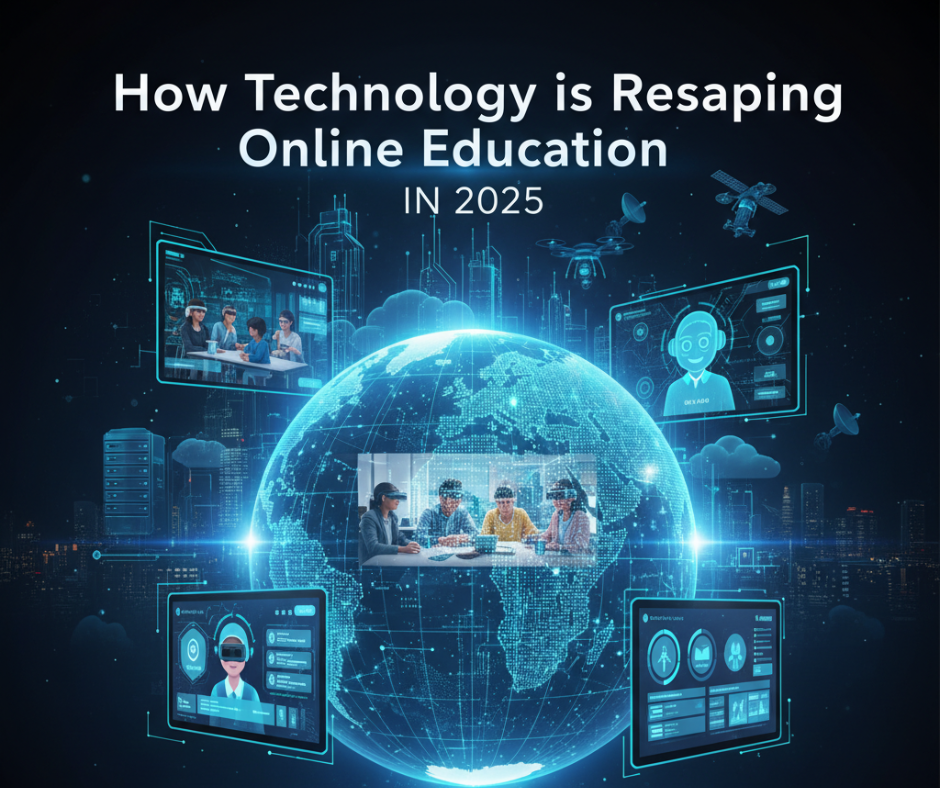
How Technology is Reshaping Online Education in 2025
The year 2025 marks a new era in online education — one defined by innovation, personalization, and global accessibility. What once started as a backup option during the pandemic has now evolved into a mainstream mode of learning, powered by cutting-edge technology. From Artificial Intelligence (AI) tutors to immersive Virtual Reality (VR) classrooms, technology is reshaping how students learn, teachers teach, and institutions operate.
In this blog, we’ll explore how technology is revolutionizing online education in 2025, the tools driving this change, and what the future holds for students and educators alike.
1. Artificial Intelligence: The Heart of Personalized Learning
AI has become the backbone of modern online education. In 2025, it’s not just an add-on — it’s an essential part of the learning experience.
AI algorithms now analyze each student’s progress, learning style, and weaknesses to create customized learning paths. Instead of a one-size-fits-all curriculum, students receive adaptive lessons that match their pace and understanding.
Platforms like Coursera, Udemy, and Khan Academy use AI tutors to explain complex topics, answer questions in real time, and provide instant feedback. Students no longer wait days for grades — AI assessments evaluate assignments within minutes.
Moreover, AI-driven chatbots and virtual assistants help manage schedules, remind students of deadlines, and even offer emotional support, creating a 24/7 learning companion.
2. Virtual and Augmented Reality: The New Classroom Experience
Imagine attending a biology class where you walk through a 3D model of the human body or exploring historical landmarks without leaving your room. In 2025, Virtual Reality (VR) and Augmented Reality (AR) make this possible.
VR headsets and AR-compatible devices are transforming how students engage with lessons. They can now experience learning instead of just reading about it. Engineering students can conduct virtual experiments; medical students can practice surgeries in realistic simulations; geography students can explore digital maps in 3D.
This immersive learning environment boosts retention and engagement, making education more interactive and exciting. With affordable VR tools becoming mainstream, this technology is no longer limited to elite institutions — it’s available to anyone with a stable internet connection.
3. Cloud-Based Learning: Accessibility Without Boundaries
The cloud continues to play a crucial role in reshaping online education. By 2025, cloud-based platforms have made learning materials accessible anytime, anywhere.
Students can now access lectures, assignments, and notes from multiple devices, ensuring flexibility and collaboration. Teachers can upload course content, track progress, and provide instant feedback through cloud systems like Google Classroom, Microsoft Teams, and Canvas.
This seamless integration also supports hybrid learning, where students can choose between attending live sessions or watching recorded lectures. The cloud ensures that no student is left behind, regardless of their location or schedule.

4. Gamification: Making Learning Fun and Interactive
The concept of gamification — integrating game-like elements into education — has taken off in 2025. Modern learning platforms use points, badges, leaderboards, and progress tracking to make studying more engaging.
Students are rewarded for completing lessons, achieving milestones, or collaborating in group activities. This motivates them to stay consistent and transforms learning from a chore into a fun, goal-oriented experience.
Apps like Duolingo, Kahoot!, and Quizizz have already mastered this model, and now many universities and online learning portals are adopting gamified systems to keep learners motivated and active.
5. Blockchain Technology: Ensuring Transparency and Security
Blockchain isn’t just for cryptocurrencies — it’s reshaping online education too. In 2025, blockchain is being used to verify academic credentials, secure student data, and track learning achievements.
With fake degrees and online scams on the rise, blockchain provides a transparent and tamper-proof system for managing student records. Educational certificates can now be issued digitally, stored securely, and verified globally with a single click.
This not only saves time but also builds trust between institutions and employers, making online degrees as credible as traditional ones.

6. Artificial Tutors and AI Study Companions
AI tutors have become smarter, more responsive, and more personalized in 2025. Unlike traditional online courses, AI tutors provide real-time guidance, adapt explanations based on student behavior, and even use voice recognition to understand doubts.
For example, students can ask, “Explain quantum physics in simple terms,” and receive customized explanations, visuals, and examples. Tools like ChatGPT, Socratic by Google, and Khanmigo are leading this wave, acting as virtual study partners available anytime.
These tools empower students to learn independently while still feeling supported.
7. The Rise of Microlearning and Bite-Sized Education
Attention spans are shorter than ever, and technology has adapted to this trend. In 2025, microlearning — delivering lessons in small, digestible chunks — is the preferred method for many online learners.
Platforms now break long lectures into short videos, quizzes, or infographics that can be completed in under 10 minutes. Students can learn on the go — during a commute, lunch break, or between classes.
Microlearning not only saves time but also improves retention, making it perfect for busy students balancing multiple commitments.
8. The Power of Data Analytics in Education
Data analytics is another powerful tool transforming online learning. Educational platforms now collect and analyze student performance data to identify strengths, weaknesses, and engagement patterns.
Teachers use these insights to adjust teaching methods, while students can view their learning progress in detailed dashboards. Predictive analytics can even warn educators when a student is at risk of falling behind, allowing timely interventions.
By making education data-driven, institutions can deliver personalized, evidence-based learning experiences that lead to better outcomes.
9. Collaborative Learning Platforms and Global Classrooms
Technology in 2025 has blurred the boundaries between countries and classrooms. Students from different parts of the world now collaborate on projects, attend global workshops, and learn from international instructors.
Platforms like Zoom, Microsoft Teams, and Slack have evolved into virtual learning communities, fostering teamwork and cultural exchange. This global connectivity enriches education by exposing students to diverse perspectives and skill sets — something traditional classrooms often lack.
10. Lifelong Learning and Upskilling Platforms
In today’s fast-paced world, education doesn’t end with a degree. Technology-driven platforms like LinkedIn Learning, Skillshare, and Coursera promote lifelong learning, helping professionals upskill and stay competitive.
AI-powered course recommendations ensure learners can quickly find relevant topics, while gamified progress trackers keep them motivated. In 2025, this trend has made continuous learning more accessible than ever, allowing individuals to upgrade their skills anytime, anywhere.
The Future of Education: Blending Humanity with Technology
As we move deeper into 2025, it’s clear that technology isn’t replacing teachers — it’s empowering them. Human educators remain essential for providing empathy, mentorship, and real-world insights that machines can’t replicate.
The future lies in blended education, where human expertise meets technological efficiency. Together, they create an environment that’s interactive, inclusive, and tailored to each learner’s unique needs.
Conclusion
The transformation of online education in 2025 is nothing short of remarkable. With AI, VR, blockchain, and data analytics at its core, the learning experience is becoming more personalized, secure, and globally connected.
Students can now access quality education from anywhere in the world, breaking down barriers of geography, cost, and accessibility. As technology continues to evolve, the classroom of the future will not just be online — it will be everywhere.