
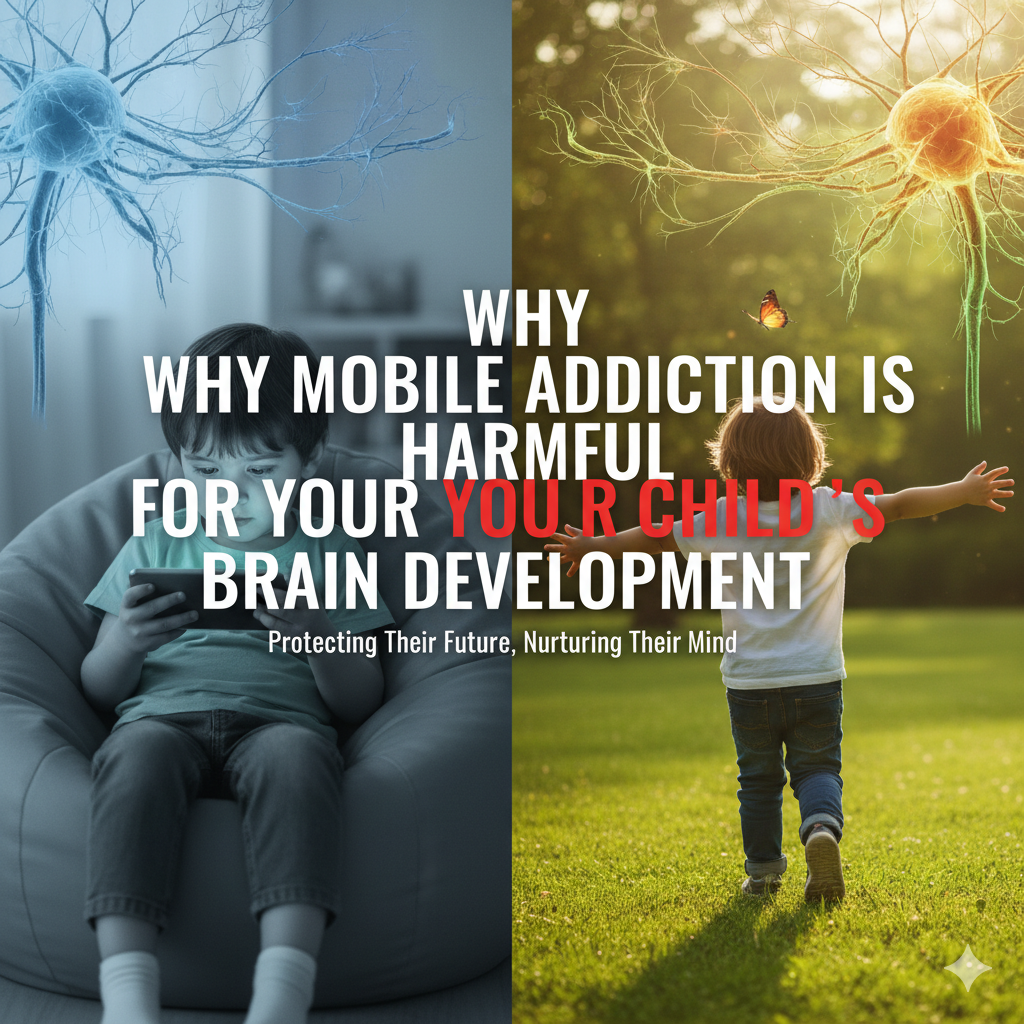
Why Mobile Addiction Is Harmful for Your Child’s Brain Development
In today’s digital world, mobile phones have become a part of daily life — even for children. From online learning to entertainment, kids spend more time on screens than ever before. While technology can be educational and useful, excessive mobile use can have serious effects on a child’s brain development, mental health, and learning abilities.
As parents and teachers, it’s important to understand how mobile addiction forms, what it does to the brain, and how we can protect children from its negative impact.

1. Understanding Mobile Addiction
Mobile addiction is a form of behavioral addiction — much like gambling or gaming addiction — where a person feels a constant urge to use their smartphone, even when it’s not necessary.
For children, this can mean spending hours on YouTube, social media, or mobile games. Over time, this behavior rewires the brain’s reward system, making the child crave more screen time to feel “happy” or “engaged.”
Key signs of mobile addiction in children:
- Irritability when the phone is taken away
- Constant need to check notifications
- Lack of interest in outdoor activities
- Poor focus on studies or homework
- Sleep disturbances due to late-night screen use
2. The Science Behind It: How Screens Affect the Brain
Children’s brains are still developing — especially the parts responsible for attention, emotional control, and decision-making. When they spend too much time on mobile devices, it affects how their brain forms connections.
Apps and games are designed to trigger the brain’s dopamine system, the chemical that creates feelings of pleasure and reward. Each time a child gets a like, wins a game, or watches a funny video, dopamine is released — and the brain starts craving more of it.
Over time, this leads to:
✅ Reduced attention span – Children struggle to focus on long tasks.
✅ Poor impulse control – They seek instant gratification.
✅ Weakened memory – Excessive screen time affects short-term memory and learning retention.
3. Emotional and Behavioral Effects
Mobile addiction doesn’t just affect the brain — it also impacts emotional development. Studies show that excessive screen time is linked to anxiety, depression, and mood swings in children.
When kids spend more time on screens than with family or friends, they miss out on learning social skills, empathy, and emotional regulation. This can make them more prone to frustration, isolation, and even aggression.
Common emotional effects:
- Increased irritability
- Social withdrawal
- Poor communication skills
- Decreased self-esteem due to social media comparison
4. Impact on Sleep and Concentration
Blue light from screens can interfere with the production of melatonin, the hormone that regulates sleep. Children who use phones before bedtime often have trouble falling asleep and experience poor-quality rest.
Lack of sleep leads to fatigue, lower concentration, and poor academic performance. Over time, this can also contribute to memory problems and slower cognitive growth.
Tip: Experts recommend no screen time at least one hour before bed and setting a “digital curfew” for children.

5. Academic Consequences
Children addicted to mobile devices often struggle in school. They find it difficult to sit still, focus during lessons, and complete assignments. The instant-reward nature of digital media makes traditional learning feel “boring.”
This over-reliance on screens weakens their ability to think critically, solve problems, and stay disciplined — skills that are essential for long-term success.
Did you know?
Research shows that children who spend more than 4 hours per day on screens score lower on language, literacy, and attention tests compared to those with limited screen exposure.
6. Physical Health Problems
Excessive mobile use doesn’t only harm mental development — it also takes a toll on physical health.
Common issues include:
- Eye strain and headaches due to prolonged screen exposure
- Poor posture and neck pain from looking down at devices
- Obesity caused by reduced physical activity
- Reduced outdoor playtime, which affects overall fitness and social development
Children need real-world play to build coordination, strength, and creativity — something that screens can never replace.
7. How Mobile Addiction Affects Social Skills
Children learn communication, empathy, and cooperation through face-to-face interactions. When they spend too much time on screens, they lose these vital experiences.
Online communication often lacks emotional cues like facial expressions and tone of voice, making it harder for children to develop emotional intelligence. Over time, they may become socially awkward or prefer virtual interactions over real ones.
Healthy social growth requires:
- Family conversations
- Group play
- School activities and teamwork
8. Setting Healthy Digital Boundaries
Preventing mobile addiction isn’t about banning technology — it’s about creating balance. Technology can be a powerful learning tool when used wisely.
Here are some strategies to manage screen time effectively:
✅ Set daily screen limits (e.g., 1–2 hours for non-educational use).
✅ Encourage offline hobbies like reading, drawing, or sports.
✅ Use parental control apps to monitor usage.
✅ Create “no phone” zones during meals or family time.
✅ Be a role model — children imitate what they see.
When parents and teachers set healthy digital habits, children naturally follow.
9. Encouraging Productive Use of Technology
Not all screen time is harmful — what matters is how it’s used. Teaching children to use technology for learning instead of distraction can make a huge difference.
For example, encourage your child to:
- Watch educational videos on science or history.
- Learn creative tools like Canva or WordPress (for older kids).
- Explore coding, digital marketing, or SEO basics in fun, interactive ways.
This approach helps children develop digital literacy — a crucial skill in today’s tech-driven world — without falling into unhealthy habits.
10. The Role of Parents and Educators
Both parents and teachers play a key role in guiding children’s relationship with technology.
Parents can model responsible screen behavior and create a family routine that balances study, play, and rest.
Educators can integrate technology in classrooms in a way that encourages creativity and collaboration, not addiction.
Together, they can help children become responsible digital citizens — individuals who use technology wisely, not excessively.
Conclusion
Mobile phones are powerful tools, but when overused, they can slow down a child’s brain development, learning ability, and emotional growth. By setting healthy limits, encouraging outdoor activities, and teaching children to use technology mindfully, we can protect their mental and physical well-being.
The goal isn’t to take technology away — it’s to teach balance and purpose. Let’s help our children grow in a world where they control technology, not the other way around.